
OceanX Shark Video Fact Check and Filming Date
This OceanX shark video fact check traces the footage to the June 2019 Bahamas expedition. OceanX and the Florida Museum published records of the dive in 2019. November 2026 dates refer to renewed reporting on the clip.
Updated
| Field | Detail |
|---|---|
| June 29, 2019 | Documented dive off Eleuthera Florida Museum |
| July 1, 2019 | OceanX publishes the expedition record OceanX mission log |
| February 24, 2023 | OceanX shares a short excerpt on TikTok OceanX on TikTok |
| November 22, 2026 | OutKick reports renewed circulation OutKick |
How this OceanX shark video fact check dates the footage
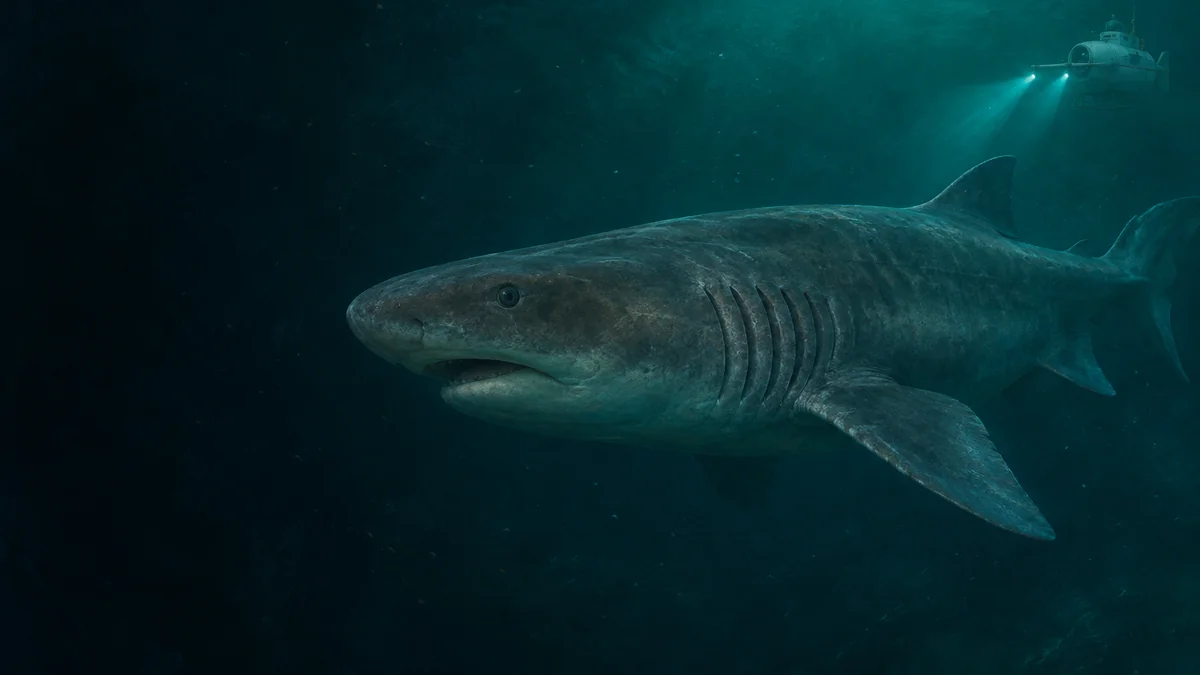
Start with a published record you can place before the latest share. The Florida Museum’s July 2019 story identifies a dive on June 29 off Eleuthera and includes a link to OceanX footage. The article names the research vessel Alucia, the submersible Nadir and the scientists involved. It describes the large female’s approach and the separate tagging of a male. The combination of a date, a named craft, a location and the original publisher’s link makes the article the best starting point.
Now compare that account with the OceanX mission log dated July 1, 2019. OceanX describes a series of attempts to tag a sixgill, the eventual deployment on a male, and the confirmation relayed from the sub. The mission log and the museum article were written from different vantage points. Read together, they tie the same fieldwork to 2019 more securely than the date on any later mirror.
The February 2023 TikTok excerpt supplies a separate checkpoint. Its account name and posting date show when this five-second cut appeared. The November 2026 OutKick report supplies evidence of later coverage and identifies the original encounter as a 2019 dive. Both later dates are useful because they can be read as part of the circulation history.
What the shark video can establish on its own
Watch for the animal approaching the observation window and turning as the light catches it. These are visible actions. A date, exact depth, body length and a species name require other kinds of evidence. For the date and location, use the expedition records. For the species, pair the team’s identification with the museum’s anatomy reference. For length, trace the published estimate back to the people cited in the account.
Shortened copies of the OceanX shark video can preserve genuine frames while changing the impression they give. The same animal can appear in a short excerpt, a narrated report and a longer edit. Sound, titles and cuts may vary. When checking a claim about the blue reflection near 52 seconds, first establish which cut the reporter describes. The five-second excerpt linked on the video page has its own running time.
A useful comparison uses more than one frame. Compare the shape and orientation of the view through the sphere, the direction of the shark’s turn and where the eye appears relative to the snout. Those visual checks can help match an excerpt to a longer video. Cite the expedition accounts when a caption adds details outside the frame.
Audit the 17-foot, 1,700-foot and 1,000-meter figures
Check the noun that follows each number. The museum gives about 16 feet as an estimate for the female. OutKick gives 16 to 17 feet in the article and puts the top end in the headline. Neither source gives a direct measurement of her entire body. Converting the estimate to approximately 4.9 to 5.2 meters preserves its scale if you keep the range.
The depth figure of more than 1,700 feet refers to the male when the tag was deployed. In the museum account, Gavin Naylor fired the tag as the male passed. The team used video to verify attachment. That observation tells you where the tagging took place. The close female footage does not provide a separately verified reading for its most familiar frames.
The 1,000-meter figure comes from Triton and describes the rated depth of the vehicle model. It does not come from the tag or the camera. An accurate description can give all three numbers if it states which animal or object each one describes and who reported it.
Check whether multiple articles add independent evidence
The November 2026 coverage can make several search results look like separate confirmations of the same claim. Follow the link next to the number or observation. An article that quotes the Florida Museum for the tagging depth is repeating that source. It documents that the statement was published on its own date, while the measurement still traces to the same 2019 account.
Newsweek’s August 2019 report is another dated point in the public record. It describes the female in the video and quotes people on the expedition. Alongside the mission log and museum account, it helps evaluate a caption that presents this footage as newly released or newly discovered.
Apply the check to a repost headline
Suppose a caption says a new 17-foot shark was filmed at 1,700 feet. Break that wording into three claims. The dated expedition records place the filming in June 2019. The length is based on an estimate for the female. The recorded depth belongs to the tagging of a male, so a caption that attaches it to the female’s close-up needs a separate depth record.
Check the credit on any still image that accompanies the repost. An editor may use a picture of another sixgill or craft to illustrate the story. If the caption or photographer’s credit gives a different vessel or year, keep that image’s provenance in the caption you share.
Example of a caption that preserves the evidence
For this encounter, a caption could say, “A female bluntnose sixgill approaches the window of Nadir during OceanX’s June 2019 expedition in the Bahamas. The footage circulated again in November 2026.” If you are sharing the TikTok cut, cite the OceanX post and give its February 2023 upload date alongside the filming period.
If you want to include a body length, say who supplied it. About 16 feet comes from the museum’s account. The 17-foot wording comes from the later report and accompanies a 16-to-17-foot range in its text. If you want to describe the research milestone, say explicitly that the team fitted a satellite tag to a male during the expedition. The window footage illustrates the encounter with the female.
What remains uncertain in circulating copies
The dated sources establish the mission, the vehicle, the species and the fact that the footage circulated long before the 2026 report. They give limited evidence about the original upload timestamp of every edit. If a platform shows a recent date, it can reliably date that particular post. An archived link from the 2019 museum story helps date the earlier material even if a player displays limited information.
Share a link to the earliest traceable source as well as the specific version under discussion. That gives readers a way to check whether a caption has changed and whether a reference to a frame still applies. If the exact time underwater, the position of the camera or a precise total length is central to the claim, look for the expedition’s own records before including those details.
Sources
- Florida Museum — Florida scientists tag deep-sea shark from submersibleJuly 2019 account with participant interviews, the 2019 dive record and a link to OceanX footage.
- OceanX — We Tagged a Bluntnose Sixgill Shark (Finally!)July 1, 2019 mission account covering earlier attempts, the Bahamas team and the successful tag.
- OceanX on Facebook — footage of the diveThe OceanX post linked directly from the Florida Museum's 2019 expedition account.
- OceanX on TikTok — sixgill shark at the submersible windowA five-second excerpt published by OceanX on February 24, 2023.
- OutKick on Fox News — Massive 17-foot shark comes face-to-face with scientistsNovember 22, 2026 coverage documenting renewed circulation and the later headline estimate.
- Triton Submarines — Nadir and the Triton 3300/3 in Blue Planet IIManufacturer background on the original 3300/3 model, Nadir and its use aboard Alucia.
- Florida Museum — Bluntnose Sixgill Shark (Hexanchus griseus)Species reference for field marks, habitat, geographic distribution, behavior and size context.
- Newsweek — Scientists film a bluntnose sixgill from NadirContemporaneous reporting describing the female in the footage and interviewing expedition researchers.