
Nadir Submersible Specs and the 2019 OceanX Dive
The Nadir submersible is a Triton 3300/3 that carried a pilot and up to two passengers. It was launched from Alucia during the 2019 Bahamas expedition, when scientists filmed a bluntnose sixgill shark at the window and fitted a different shark with a satellite tag.
Updated
| Field | Detail |
|---|---|
| Vehicle model | Triton 3300/3 Triton Submarines |
| Occupancy | One pilot and two passengers Triton Submarines |
| Model depth rating | 1,000 m, approximately 3,280 ft Triton Submarines |
| 2019 ship | Alucia Florida Museum |
| 2019 pilot | Lee Frey Florida Museum |
How to identify the Nadir submersible in source material
The strongest identification pairs the vehicle's name with a mission and ship. Triton's account names Nadir as a Triton 3300/3 carried aboard Alucia during Blue Planet II. The Florida Museum then names Nadir and Alucia together in its account of the 2019 Bahamas dive. Those two records connect the same named craft to two distinct assignments.
If you are comparing pictures of OceanX equipment, start with the image credit and caption. A transparent sphere is a recognizable design feature, but different vehicles can use a similar layout. A later fleet photograph can document the same type of work without depicting the craft that carried the scientists on June 29. A label that gives the vehicle name, the vessel and the expedition is stronger evidence than an uncaptioned image.
The original Triton 3300/3 also has model successors. Detailed dimensions, maximum speed or endurance attributed to a current version in a sales sheet should be tied to that version. For the Nadir submersible, the entries in the table above come from the manufacturer’s named-craft account and the museum’s 2019 mission record.
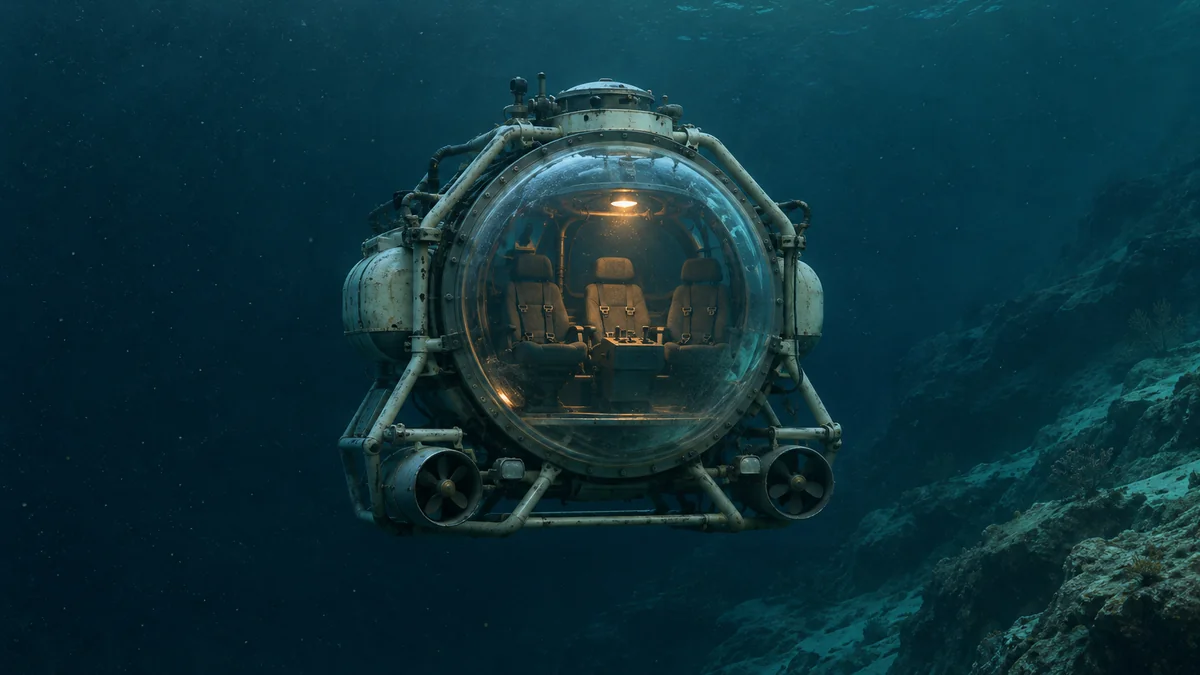
How the Nadir submersible’s viewing sphere shaped the footage
The Florida Museum describes the interior of Nadir as a globe. The clear sphere gave the crew a wide field of view. A researcher could follow an animal's path as it moved around the vehicle. A camera pointed through one part of the sphere sees a narrower view, which helps explain why a clip can show the eye and snout while the rest of the shark stays out of frame.
The crew descended into dark water where the lamps defined the part of the scene they could observe. As a shark moved across the edge of the lit area, the crew would see different parts of its body in succession. That is useful context for a clip where the female seems to appear suddenly from the dark.
What three seats made possible for the 2019 dive
In Triton's specification, the three places include a pilot and two passengers. The pilot controls the vehicle and can bring the observers close enough to study the slope and watch a shark approach. The researchers need a position where they can follow the animal's movement while the vehicle stays oriented toward the area in view.
The June dive shows why the pilot and observer roles matter. The museum identifies Lee Frey as the pilot and Gavin Naylor as the researcher who deployed the successful tag. Nadir supported both the close observation at the window and the separate moment when the male passed in a position where Naylor could act. At the surface, Alucia supported the deployment and the return.
Space for a pilot and two passengers is the model's occupancy specification. It does not by itself establish the complete passenger list for one particular dive. The published account is the right source for names and roles, just as Triton is the right source for the model rating.
How deep could the Nadir submersible dive?
The manufacturer's figure of 1,000 meters describes the model. In imperial units, Triton quotes approximately 3,300 feet. Using the ordinary unit conversion gives about 3,281 feet. These values express the same nominal depth rating to different levels of precision.
For the 2019 dive, the museum reports a male sixgill being tagged at more than 1,700 feet, or a little over 518 meters. That depth belongs to an event during the dive. A line in a specification sheet and a depth noted in a mission account may both be accurate while answering different questions. Neither number supplies the camera depth at every moment of the shark video.
Apply the same distinction when looking at the shape of Exuma Sound. In reporting on the earlier 2018 survey, Mongabay described research descents to about 800 meters. That number describes prior exploration on the slopes of the basin. It does not move the 2019 tagging site to 800 meters, nor does it set the operating limit of the Nadir submersible.
Two submersibles aboard Alucia
Mongabay’s account of the earlier 2018 Exuma Sound work describes two craft deployed from Alucia. Nadir was the three-seat Triton 3300/3. Deep Rover had two seats and an external manipulator arm used for collecting specimens or operating sampling equipment. The report gives both craft a 1,000-meter depth capability.
A retroactive caption that identifies the craft only by ship and depth rating leaves the identity open. Use the museum’s named account for the 2019 shark dive and the image credit or equipment description for an earlier survey photograph. Images from both missions may show Alucia or the same stretch of coast.
From documentary filming to field research
Before the Bahamas tagging mission, Nadir supported underwater filmmaking for Blue Planet II. Triton says Nadir was fitted with 8K cameras for that work and accumulated more than 500 hours of recorded dive time in the production. Triton's report describes typical filming dives of six to eight hours and some longer dives. Those are production records and should stay with the filming assignment.
The skills required for documentary work and research overlap. A pilot may need to hold a view of an animal or a feature on the seafloor as the crew watches. The June 2019 expedition used the craft to test whether an instrument could be attached to a bluntnose sixgill at its normal depth.
Observations made through the sphere can be checked against recordings once the craft returns. In the museum's account, silt obscured the immediate view after the tagging attempt. The crew used the video record to resolve whether the tag was on the male. The footage of the larger female shows how the platform provides a direct view of an animal approaching the craft.
Which records establish the specifications?
For the model and passenger capacity, start with Triton's release naming Nadir and the 3300/3. For the 2019 deployment, use the Florida Museum and OceanX mission accounts to confirm the pilot, ship and work carried out at depth. Keeping those references together makes it easier to distinguish a model feature, a historical fitting and an observation from an individual dive.
The public accounts give a good picture of the vehicle's role and the layout that made observation practical. They do not provide a full equipment inventory or a certified dive log for the footage. If you need exact camera settings, ballast, dimensions or dive times for this expedition, those details would require a record specific to Nadir and the assignment.
Sources
- Triton Submarines — Nadir and the Triton 3300/3 in Blue Planet IIManufacturer background on the original 3300/3 model, Nadir and its use aboard Alucia.
- Florida Museum — Florida scientists tag deep-sea shark from submersibleJuly 2019 account with participant interviews, the 2019 dive record and a link to OceanX footage.
- OceanX — We Tagged a Bluntnose Sixgill Shark (Finally!)July 1, 2019 mission account covering earlier attempts, the Bahamas team and the successful tag.
- Mongabay — Underwater tech unlocks the secrets of The Bahamas’ Exuma SoundReporting from earlier Exuma Sound work with the Cape Eleuthera Institute and Alucia.