
Bluntnose Sixgill Shark Size, Habitat and ID
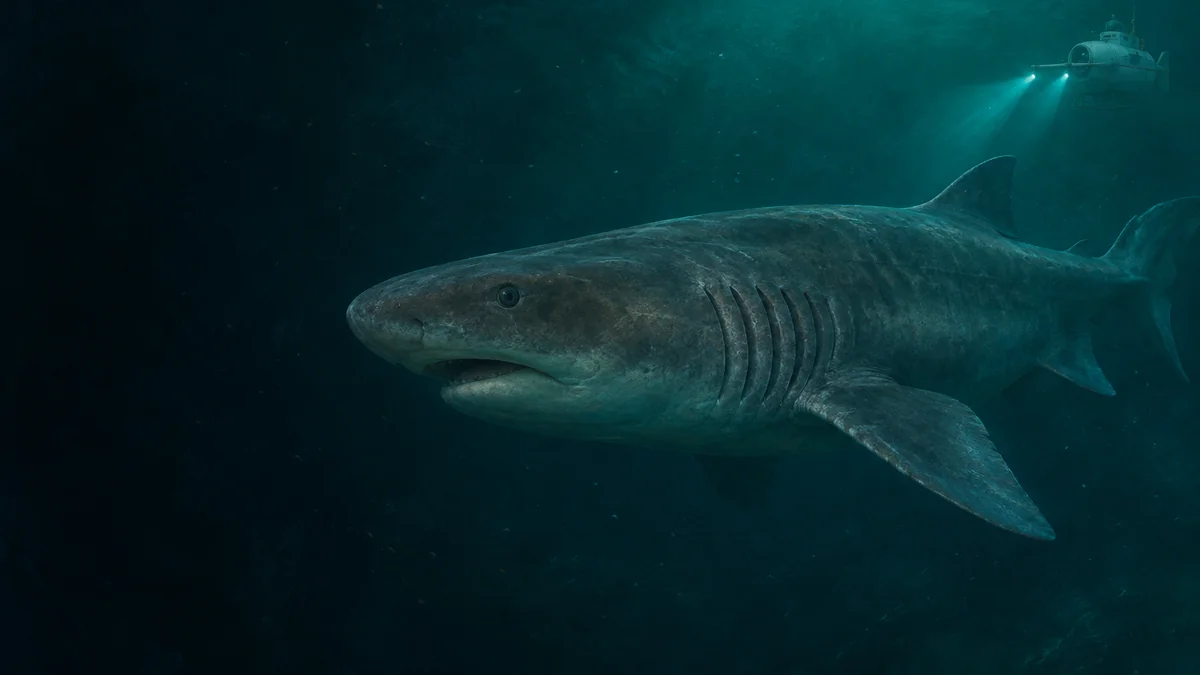
The bluntnose sixgill shark (Hexanchus griseus) is a large deep-water shark with a broad head, six gill slits per side and one dorsal fin placed far back. A large female of this species approached Nadir’s window in the 2019 Bahamas footage.
Updated
| Field | Detail |
|---|---|
| Scientific name | Hexanchus griseus Florida Museum species profile |
| Gill slits | Six on each side Florida Museum species profile |
| Dorsal fins | One, set well back Florida Museum species profile |
| Habitat | Deep shelves and upper slopes in temperate and tropical seas Florida Museum species profile |
Field marks of the bluntnose sixgill shark
The best view for identification is a broadside pass. Start at the head and count the long gill slits where the head meets the body. Look for six on the visible side, then check farther back for a single dorsal fin close to the pelvic fins. The Florida Museum also describes a stout tail base and a broad, flattened head. Several features seen together give a stronger identification than the shape of the snout by itself.
A cropped view may cut off the dorsal fin or hide some of the gill slits behind the curve of the head. In the OceanX footage, the people on the expedition saw the animal and could compare several views. Their account is useful when the match depends on an eye reflection or the outline of a single frame. Use the museum's species profile for anatomy and its expedition account for the identification of this individual.
The teeth offer another clue in specimens or well-lit photographs. The museum describes broad, comb-like teeth in the lower jaw and narrower teeth in the upper jaw. A shark moving past a window may keep its mouth closed, so the position of the dorsal fin and the gill slits are usually more practical features for video viewers.
How to tell a bluntnose sixgill from a bigeye sixgill
The Florida Museum describes the bigeye sixgill as a smaller, more slender shark with a narrow, pointed head. It typically grows to between five and a half and just under six feet. The bluntnose has a broader head and a heavier body. Both have six gill slits and a single dorsal fin set toward the tail, so those two features alone identify the general type.
The museum lists the Bahamas among the places where bigeye sixgills have been recorded. Location alone therefore leaves both possibilities open. For the OceanX animal, the broad head and the expedition team’s identification support the bluntnose. Use body size as a secondary clue when a source gives an estimate or a view has a reliable scale.
How deep does a bluntnose sixgill shark swim?
The species occurs across temperate and tropical seas, often around deep shelves and upper slopes. Individuals can use several depths in a single day. A 2020 PLOS ONE study of sharks off Hawai‘i reported a pattern of deeper daytime movements below 500 meters and shallower nighttime use around 200 to 350 meters. Scientists call this daily movement through the water column diel vertical migration.
The same study used sensors to record depth, temperature and fine-scale movement. The sharks it followed spent part of the day in water around 5 to 7 degrees Celsius with low dissolved oxygen. They remained active across both depth phases. That result comes from the study animals in Hawaiian waters. Local conditions and individual behavior matter when comparing those measurements to the June 2019 Bahamas dive.
Sixgills can also turn up in shallow water. Researchers working with the Seattle Aquarium documented them in Elliott Bay, Puget Sound, and used underwater video and visual tags to study seasonal patterns at a local research site. The paper found more observations in summer at that site. The example shows why the phrase deep-water shark describes a common habitat while leaving room for regional and seasonal differences.
Life history and why repeated observations matter
Published field work describes the bluntnose sixgill shark as slow growing and late to mature. A large animal seen in a brief clip cannot be assigned an age from its size alone. A time series of sightings or measurements can help researchers investigate how sharks of different sizes use a particular area. Researchers in Puget Sound noted that many sightings could involve the same individuals returning to one site.
A count of encounters is therefore different from a count of unique animals. In the Puget Sound study, recognizable marks and tagged animals helped researchers track repeat visits. The team reported changes in relative abundance at its research station rather than a population count for the whole species. Sightings from one dive off Eleuthera have an even narrower use: they document the animals the crew observed during that operation.
The Bahamas scientists had a different goal. They wanted depth, temperature and light readings as a shark moved away after being tagged. A satellite tag designed to detach and transmit at the surface could extend observations beyond the boat and the camera. The female seen at the window was one observation of the species during the trip. The tagged male provided the opportunity to collect the longer record.
Feeding and the close approach
The bluntnose sixgill shark feeds in low light and can take living prey or scavenge. The museum describes broad, comb-like lower teeth, a feature that can be seen in specimen photographs. Researchers interviewed after the Bahamas encounter also described scavenging as part of the animal’s feeding ecology. The window footage captures how the female moved around the craft during one field observation.
The research team took bait as part of its tagging effort. That context helps explain why the encounter differs from a randomly sampled sighting. The mission records describe the setup and the female’s movements, and leave open what brought her to the window or how another sixgill might approach a different object.
What the fossil comparison describes
The Florida Museum notes the similarity between the bluntnose sixgill shark and some fossil sharks known from the Triassic. The comparison describes features recognizable in the lineage. Fossils offer evidence about past animals, while the modern species profile describes the living animal’s anatomy, geographic range and habitat.
The reports from Hawai‘i and Puget Sound show why the living species still needs to be studied in different settings. One project recorded vertical movement off a tropical island. The other tracked seasonal changes in sightings in an urban waterway. Those measurements answer questions about living sharks that the resemblance to fossils cannot resolve.
Comparing size figures across sources
The museum's profile describes a typical length of roughly 15 to 16 feet. Its account of Nadir's dive gives a field estimate of about 16 feet for the female. OutKick later uses a 16-to-17-foot estimate. A scientific paper may instead give a maximum reported length for the species. Comparing those numbers requires reading the quantity in context: typical lengths, estimated length of a particular animal, and reported maximum each describe a different set of observations.
The calculation is straightforward once the source value is clear. Sixteen feet is about 4.9 meters. Seventeen feet is about 5.2 meters. Both figures still reflect an estimate if they came from the encounter account. A close pass can make the fish loom on screen, so frame size alone adds little evidence about total length.
Sources
- Florida Museum — Bluntnose Sixgill Shark (Hexanchus griseus)Species reference for field marks, habitat, geographic distribution, behavior and size context.
- Florida Museum — Florida scientists tag deep-sea shark from submersibleJuly 2019 account with participant interviews, the 2019 dive record and a link to OceanX footage.
- OutKick on Fox News — Massive 17-foot shark comes face-to-face with scientistsNovember 22, 2026 coverage documenting renewed circulation and the later headline estimate.
- Mongabay — Underwater tech unlocks the secrets of The Bahamas’ Exuma SoundReporting from earlier Exuma Sound work with the Cape Eleuthera Institute and Alucia.
- PLOS ONE — Diel patterns in swimming behavior of the bluntnose sixgillBiologging study of vertical movement, activity and environmental conditions off Hawai‘i.
- PLOS ONE — Observations on abundance of bluntnose sixgill sharks in Puget SoundStudy using underwater video and mark-resight methods at the Seattle Aquarium research site.
- Florida Museum — Bigeye Sixgill Shark (Hexanchus nakamurai)Identification and size reference for a related sixgill recorded in Bahamian waters.